
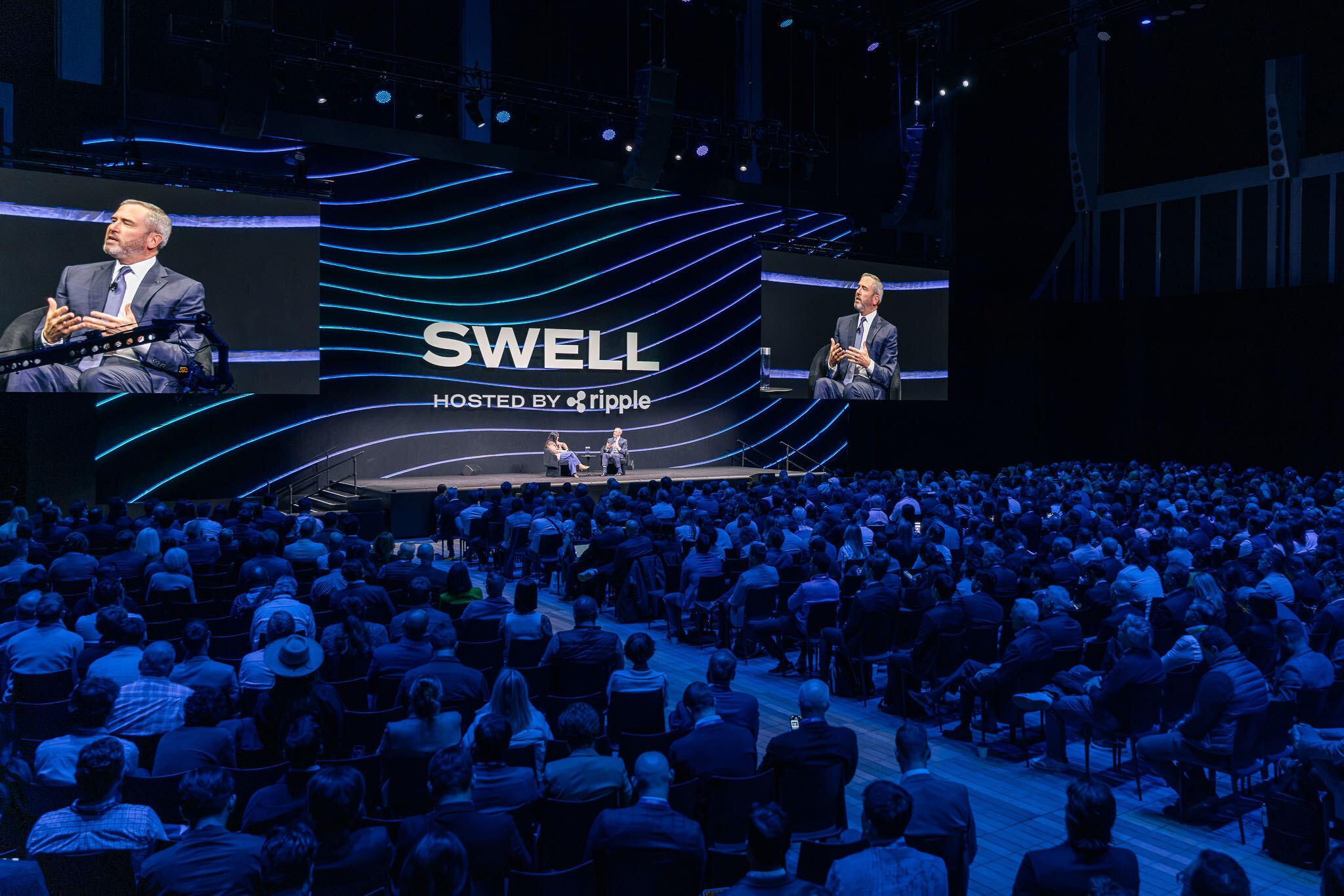
Ripple’s 10th annual Swell conference in New York City brought together leaders from traditional finance, crypto, academia, and the XRP community to look back on a decade and ahead to what comes next.
It was the largest Swell in the event’s history with over 1,500 attendees, and the one that moved the conversation about the potential of blockchain technology, showing the proof of how it’s already integrated into the global economy. Blockchain is no longer finance’s experiment. It’s becoming part of the foundation of the global economy, delivering real-world utility that is bringing traditional and digital finance together.
From tokenized money market funds and faster settlement to capital markets and trade finance, the use cases that matter most to global finance are live, and the names running them are the names that run the system.
Here are the themes that defined Swell 2026.
1. Swell 2026 was about proof, not potential
When Swell launched nearly a decade ago, it gathered people who wanted to build the financial infrastructure of the future. This year, the stage was full of people describing what they’ve built, with real customers, running in production.
“The conversation now is how quickly will it happen and will you be a winner,” said Tom Farley, CEO of Bullish.
Laide Majiyagbe, Global Head of Markets at BNY, spoke about how her 242-year-old employer is investing in its traditional rails and in digital ones at the same time. “We’re actually starting to see real use cases that can be solved,” said Majiyagbe. “What I expect next is scale.”
Ripple’s own numbers tell the same story. The company expects to exit 2026 approaching a $900 million annualized product revenue run rate, roughly 3x where it was a year ago, with more than 1,700 institutions, corporates and enterprises now using Ripple. Customers are also using more of Ripple’s solutions together: this year, Ripple saw 3x growth in customers using multiple solutions across payments, custody, stablecoin, prime brokerage, and treasury management.
2. Tokenization is becoming part of how capital markets run
There is nearly $400 billion in tokenized assets across chains today, but the real unlock isn’t just putting an asset on a blockchain. When those assets become live instruments that can be traded, financed, and used as collateral around the clock, you start to solve a mobility problem capital markets have had for decades. Tokenization makes assets programmable and mobile from the moment they’re issued.
“We are just at the beginning. Tokenization is the most exciting part of blockchain technology that we’ve seen in a long time,” said Johann Kerbrat, SVP and GM of Robinhood Crypto.
Aviva Investors launched a tokenized share class of its £22 billion Sterling Liquidity Fund on the XRP Ledger, with over £86 million now invested across its two tokenized share classes. DBS and Franklin Templeton are launching trading and lending solutions built around a tokenized money market fund. BNY now supports RLUSD and XRP on its digital asset custody platform and is working with Ripple and C2FO on tokenized trade finance.
Tokenized stocks are already trading in volume, with most of the activity after the closing bell. The tech keeps getting better too. Compliance controls are built into the tokens themselves, and settlement happens in seconds on the XRP Ledger, with both sides of a trade settling simultaneously. Think of it as better infrastructure for assets people already own.
And, tokenizing an asset is just the first step. Institutions also need the infrastructure to securely hold those assets, access liquidity, and put capital to work across traditional and digital markets. That’s where an integrated approach connecting custody, payments, and prime brokerage becomes increasingly important.
Brian Oliver, VP of RippleX Partnerships, discussed how Ripple is building an end-to-end solution to help asset managers issue and distribute tokenized funds, with Ripple Treasury as a potential channel to reach corporate treasurers. He also outlined how Ripple Custody can support safekeeping, RLUSD can serve as the cash leg for settlement, and Ripple Prime can help investors borrow against eligible fund shares.
3. Money no longer waits for Monday
Bank hours are starting to look like a relic. A corporate treasurer can put idle cash to work over the weekend and have it back before Monday through 24/7 Returns in Ripple Treasury. Cross River Bank is embedding RLUSD directly into its core banking infrastructure, so businesses can settle in stablecoins through the same API they already use for traditional payments. A supplier can get paid on an approved invoice in seconds instead of waiting 30, 60, or 90 days, with C2FO Instant Pay to settle in RLUSD on the XRP Ledger. A brokerage can run its weekend operations without parking cash in advance every Friday.
“Stablecoins just make money work harder. Every minute of the day, every day of the week,” said Monica Long, President of Ripple.
“The way businesses move money is changing, and treasury needs to evolve with it,” said Renaat Ver Eecke, SVP of Ripple Treasury. “As AI accelerates decision-making and digital rails enable money to move around the clock, businesses need systems that can keep pace.”
The appetite is showing up across markets too. Event contracts, perpetual futures, and weekend equity trading topics all drew big crowds at Swell, and the consensus was that every asset class is headed for round-the-clock trading. When money never stops moving, the infrastructure needs to keep up.
4. The XRP Ledger is more than just a payments network
The ecosystem stage explored the next phase of financial activity on XRPL, from expanding XRP’s use in DeFi to building institutional lending and credit markets.
Soil and Flare discussed opportunities to expand DeFi utility for XRP. Soil highlighted its work with Ripple to explore potential uses for XRP in credit and collateral within Ripple Payments, with the broader goal of expanding how XRP can be used in institutional finance.
A panel on “Bringing Institutional Credit on XRPL” brought together VS1, Cicada, Arf, and Clearpool to discuss their plans for the proposed XRPL Lending Protocol. The discussion covered pooling capital, originating loans, and managing repayment. The proposed Single Asset Vault and the Lending Protocol would support these functions onchain, while underwriting and credit decisions remain with the institutions providing them. Both capabilities remain subject to validator approval.
At Demo Day, held the day before Swell at Ripple’s New York City office, startups like BlockVault and Straid demonstrated how XRP holders can access liquidity without selling their assets, while VS1 is building compliant lending and tokenized capital markets directly on the ledger.
David Schwartz, CTO Emeritus at Ripple, and Ayo Akinyele, Senior Director of Engineering at RippleX, explored the future of the XRP Ledger through a series of true-or-false questions. The discussion covered XRPL’s focus on financial use cases, the trade-offs of adding new features, and what belongs onchain versus offchain. They also explored how AI could enable agent micropayments, alongside its implications for software security. They closed with rapid-fire predictions on tokenized assets, payment volume, and AI agent activity on XRPL over the next year.
5. Clear rules are giving institutions the confidence to move
Institutions move when the rules are clear, and Swell had good news on that front. Just ahead of the event, the Office of the Comptroller of the Currency (OCC) granted final approval to establish Ripple National Trust Bank, a federally chartered trust bank supervised by the OCC, the same regulator that oversees the country’s national banks. “We should want the United States to be a shining light of leadership around clear rules of the road,” said Brad Garlinghouse, CEO of Ripple.
Treasury Secretary Scott Bessent opened the conference in conversation with Garlinghouse, making the case that bringing the industry onshore under strong U.S. standards will lead other countries to adopt American rules and technology too. Speakers pointed to the GENIUS Act passing and recent SEC and CFTC rulemaking as steady progress. With 67 million Americans now part of the crypto economy, the need for clear crypto regulation grows stronger.
6. Blockchain is unlocking access to more than money
For all the talk about tokenized funds and institutional settlement, some of the clearest proof of blockchain’s value comes from places where the financial system has historically failed people.
“The promise of crypto and blockchain has always been about making money move faster, more efficiently and globally,” said Garlinghouse. “With Water.org, we’re seeing what that looks like first hand.”
Water.org co-founders Matt Damon and Gary White took the stage at Swell to show what faster, cheaper payments can do far from the trading floor. Their WaterCredit program gives families small loans to connect their homes to safe water, with a 98% repayment rate. With Ripple Payments, Water.org has moved more than $3 million across Latin America, with same-day settlement in Mexico and Brazil and fees down by up to 66%. “Working with Ripple has been huge,” Damon said. “It means faster, vastly reduced banking fees, immediate, and transparent. It’s a game changer for us.”
Water.org has now reached more than 95 million people, with a goal of 200 million by 2030. Ripple has committed $6 million over three years, plus a $1.25 million RLUSD grant to bring stablecoin-enabled WaterCredit to Indonesia, the Philippines and Uganda.
Looking ahead
The world’s financial system still runs almost entirely off chain. Trillions of dollars move through it every day, settling on rails and schedules built decades ago. The announcements at Swell 2026 are early proof of what happens when even a fraction of that activity moves on-chain: settlement compresses from days to seconds, idle capital gets put to work around the clock, and assets that sit static become liquid. The opportunity is to take the money already in the financial system and move it onto infrastructure that can keep up.
The future of finance is not crypto replacing traditional finance, or traditional finance holding crypto at arm’s length. It’s one financial system where the two work together seamlessly, each making the other stronger.
“My hope is that at some point you will just use crypto technology when it’s better, and you don’t even know that it’s happening behind the hood,” said Johann Kerbrat of Robinhood. “We’ll stop talking about crypto versus TradFi and just how do we make it even better.”
For Ripple, that means being the bridge between those worlds, continuing to build an Internet of Value where money and assets move as easily as information.
Watch additional footage from Swell 2026 or contact our sales team to get started on your digital asset strategy today.