
Payments has always been crypto’s “killer app.” The promise is simple. Move money globally with more speed, transparency and efficiency than legacy systems allow. But the execution is complex.
Ripple has been building toward and enabling that vision since day one. Now, as the stablecoin market matures, regulatory frameworks solidify and more value moves onchain, Ripple Payments is expanding again to bring fiat and digital assets together into a single, licensed, end-to-end platform for fintechs, enterprises, and financial institutions worldwide.
A Unified Vision for Global Payments
For most fintechs, the biggest barrier to scale isn’t demand, it’s complexity. Payment vendors often provide only individual pieces of the puzzle: an API, custody, access to a single stablecoin or limited corridor coverage. But the more providers involved in a payment, the greater the friction, cost and risk for the transaction. These issues compound as companies scale, forcing them to manage multiple contracts, onboarding processes and compliance regimes.
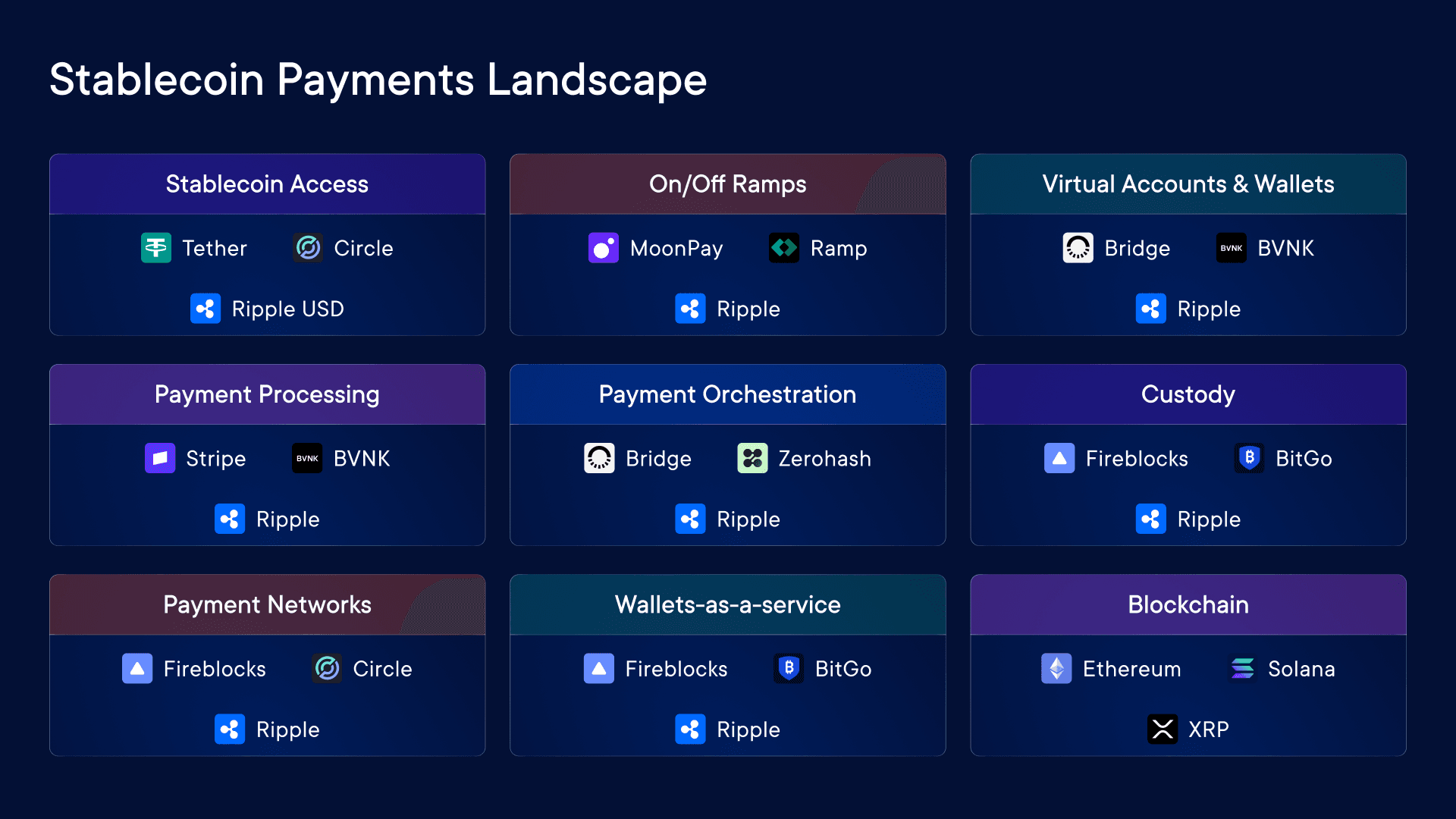
Ripple takes a fundamentally different approach. Ripple Payments is a complete, end-to-end platform for collecting, holding, exchanging and paying out all forms of value: fiat, stablecoins or other digital assets.
Backed by more than a decade of experience and over 75 licenses across key financial markets — stretching from New York to the European Union to the Monetary Authority of Singapore — Ripple is already trusted to move hundreds of billions of dollars across some of the world’s most challenging corridors.
With recent expansion, the platform brings even more of the payments lifecycle into one continuous flow. Strategic acquisitions have played a pivotal role in making this possible: Palisade strengthens custody, wallet infrastructure and treasury automation, while Rail adds global virtual accounts and collection capabilities.
In combination with Ripple’s existing liquidity management tools and its global payments network, customers can leverage digital asset payments without stitching together multiple vendors, inevitably saving time, money and operational overhead.
Now, using Ripple Payments, fintechs can:
- Collect funds globally in fiat or stablecoins, automatically convert inflows into their preferred currency and settle into a unified account. With Ripple, companies can reduce the need to establish local entities abroad, limit FX exposure while accepting and processing payments in fiat or digital assets without adding new resources.
- Hold balances using named virtual accounts and wallets that support both end users and internal treasury operations. Fiat and stablecoin balances are visible in a single, consolidated view, providing greater control and transparency across accounts.
- Exchange funds instantly 24/7/365, including direct access to RLUSD. Real-time conversions overcome traditional banking delays, trapped funds and complex mint-and-burn workflows through deep liquidity pools and Ripple’s OTC desk.
- Payout in minutes instead of days including real-time mass disbursements to suppliers, creators and employees in their preferred currency (fiat or stablecoin). Ripple reduces settlement times from days to minutes and eliminates manual processes tied to legacy rails like SWIFT.
Proven Performance on a Global Scale
While much of the industry is still piloting test rails or operating in just a handful of markets, Ripple Payments is already live at scale. The platform supports payouts across 60+ major markets, runs on 51 real-time payment rails and is backed by 20+ banking partners that ensure resilience and redundancy across the network.
Citigroup predicts stablecoin supply could reach $3.7 trillion by 2030, describing stablecoins as blockchain’s “ChatGPT moment.” So, while global enterprises and financial institutions race to modernize cross-border payments and support stablecoins, Ripple is already there. Ripple’s stablecoin, RLUSD, has surpassed $1 billion in market cap in less than a year since its launch. And Ripple Payments has processed more than $100 billion in total volume, with Rail adding another $10 billion annually.
Customers around the world have turned to Ripple to solve tangible problems of speed, liquidity, cost and access in payments without the hassle of managing multiple vendors.
- Corpay, a global leader in business payments, uses Ripple’s managed custody and liquidity management solutions to instantly fund and settle positions across Asia-Pacific with RLUSD, eliminating pre-funding requirements and unlocking new liquidity efficiencies.
- MassPay is leveraging Ripple to support global payout flows to more than 100 countries, starting with EUR, VND, THB and TRY, and with plans to expand into stablecoin-funded payouts.
- alfred relies on Ripple to power stablecoin-to-fiat flows across the U.S., Mexico, Colombia, China and beyond, benefiting from competitive pricing and broad corridor coverage.
Power Payments Without Compromise
As crypto payments move from promise to practice, the companies that succeed will be those that offer holistic solutions that operate across assets, markets and regulatory environments without friction.
Ripple Payments provides the regulatory credibility, deep liquidity and end-to-end, enterprise-grade infrastructure that fintechs need to collect, hold, exchange and move money globally.
Download The Fintech Checklist for Stablecoin Payments to learn more.